Deprecated: Return type of WP_Hook::current() should either be compatible with Iterator::current(): mixed, or the #[\ReturnTypeWillChange] attribute should be used to temporarily suppress the notice in /var/www/html/wp-includes/class-wp-hook.php on line 456
Deprecated: Return type of WP_Hook::next() should either be compatible with Iterator::next(): void, or the #[\ReturnTypeWillChange] attribute should be used to temporarily suppress the notice in /var/www/html/wp-includes/class-wp-hook.php on line 469
Deprecated: Return type of WP_Hook::key() should either be compatible with Iterator::key(): mixed, or the #[\ReturnTypeWillChange] attribute should be used to temporarily suppress the notice in /var/www/html/wp-includes/class-wp-hook.php on line 482
Deprecated: Return type of WP_Hook::valid() should either be compatible with Iterator::valid(): bool, or the #[\ReturnTypeWillChange] attribute should be used to temporarily suppress the notice in /var/www/html/wp-includes/class-wp-hook.php on line 495
Deprecated: Return type of WP_Hook::rewind() should either be compatible with Iterator::rewind(): void, or the #[\ReturnTypeWillChange] attribute should be used to temporarily suppress the notice in /var/www/html/wp-includes/class-wp-hook.php on line 506
Deprecated: Return type of WP_Hook::offsetExists($offset) should either be compatible with ArrayAccess::offsetExists(mixed $offset): bool, or the #[\ReturnTypeWillChange] attribute should be used to temporarily suppress the notice in /var/www/html/wp-includes/class-wp-hook.php on line 398
Deprecated: Return type of WP_Hook::offsetGet($offset) should either be compatible with ArrayAccess::offsetGet(mixed $offset): mixed, or the #[\ReturnTypeWillChange] attribute should be used to temporarily suppress the notice in /var/www/html/wp-includes/class-wp-hook.php on line 412
Deprecated: Return type of WP_Hook::offsetSet($offset, $value) should either be compatible with ArrayAccess::offsetSet(mixed $offset, mixed $value): void, or the #[\ReturnTypeWillChange] attribute should be used to temporarily suppress the notice in /var/www/html/wp-includes/class-wp-hook.php on line 426
Deprecated: Return type of WP_Hook::offsetUnset($offset) should either be compatible with ArrayAccess::offsetUnset(mixed $offset): void, or the #[\ReturnTypeWillChange] attribute should be used to temporarily suppress the notice in /var/www/html/wp-includes/class-wp-hook.php on line 443 Page not found
Time for a rope wash
Thursday, January 30th, 2020
Time for a rope wash
Thursday, January 30th, 2020
4min read
When was the last time that you washed your climbing rope? I have to admit that in the past it’s not something I’ve done regularly but it’s the start of a new year and I’m currently going through my gear, making sure it’s all in good shape and ready for the adventures ahead.
Your climbing rope is an important bit of kit – you literally trust your life to it. So it makes sense to look after it! Being careful with it and using rope bags and mats help, but eventually dirt and grit will get into the rope. This not only decreases the rope’s lifespan but also its handling performance.
Cleaning a rope isn’t actually a hard job and doesn’t take that long, there’s just a bit of effort required. The pain is drying it afterwards as they can take up a lot of room and take a while to fully dry. It’s possible to wash a rope in a washing machine but I’ve personally never tried this and have always hand-washed mine in the bath.
There are arguments as to whether you should use detergents or not. Ropes are super strong and can handle a lot of abuse in everyday use but can become dramatically weakened after being in contact with certain chemicals. Some people clean their ropes in just water, or you could use soap flakes – however, on this occasion I’ve used a specially formulated rope wash. The one I’ve used is by Sterling Rope (Wicked Good Rope Wash) It comes in a single use sachet which apparently is enough to clean 1 rope (I used two sachets on 2 x 60m and 1 x 70m ropes which seemed to do a very good job). If you’ve got a lot of ropes to clean, BEAL sells a rope wash that comes in a bottle. Whatever you decide to you use, you should check with the rope manufacturer to make sure it’s safe for your rope.
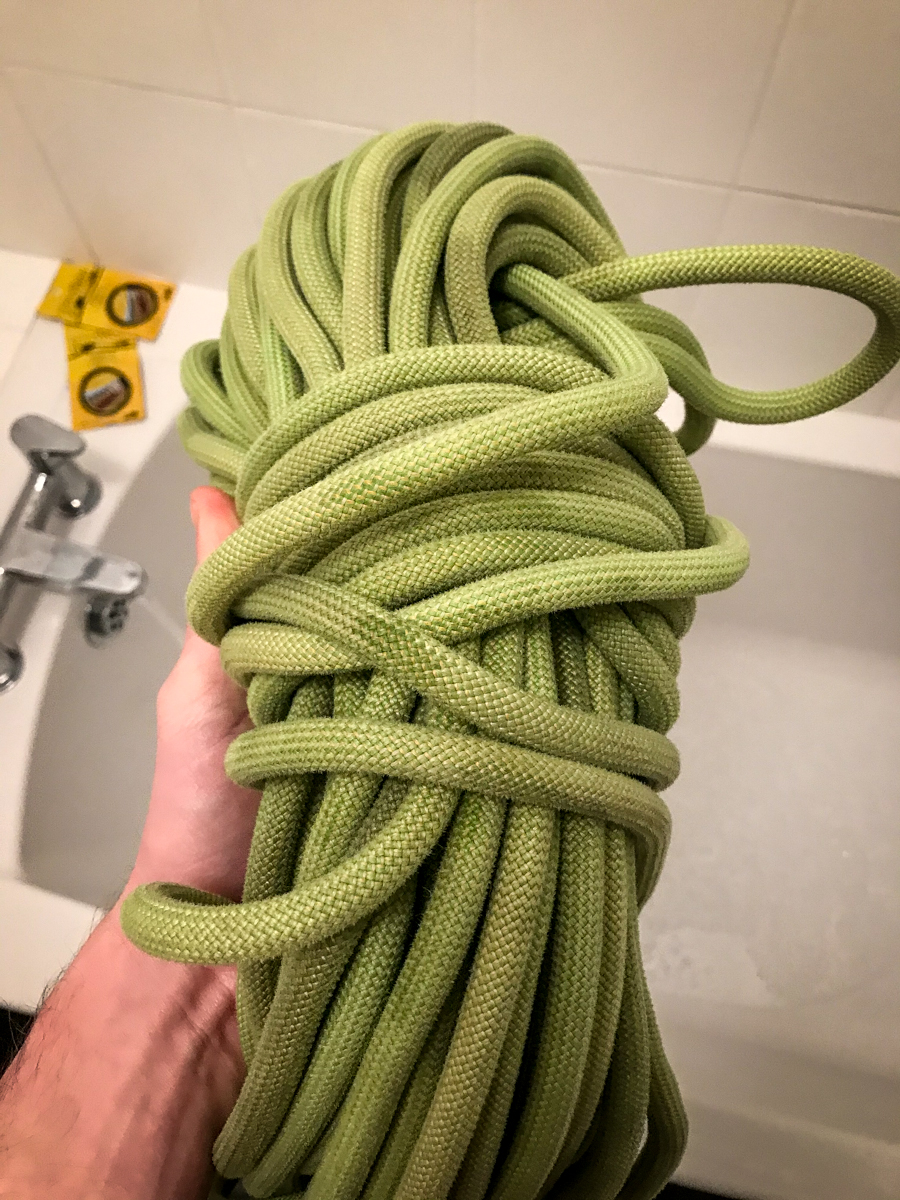
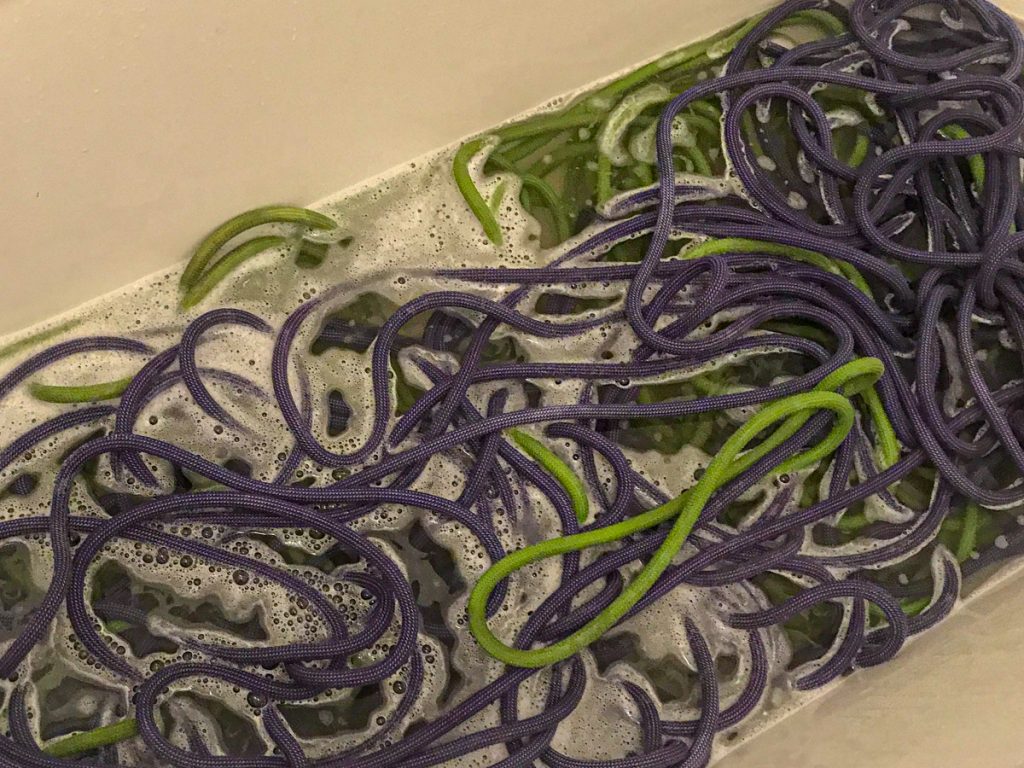
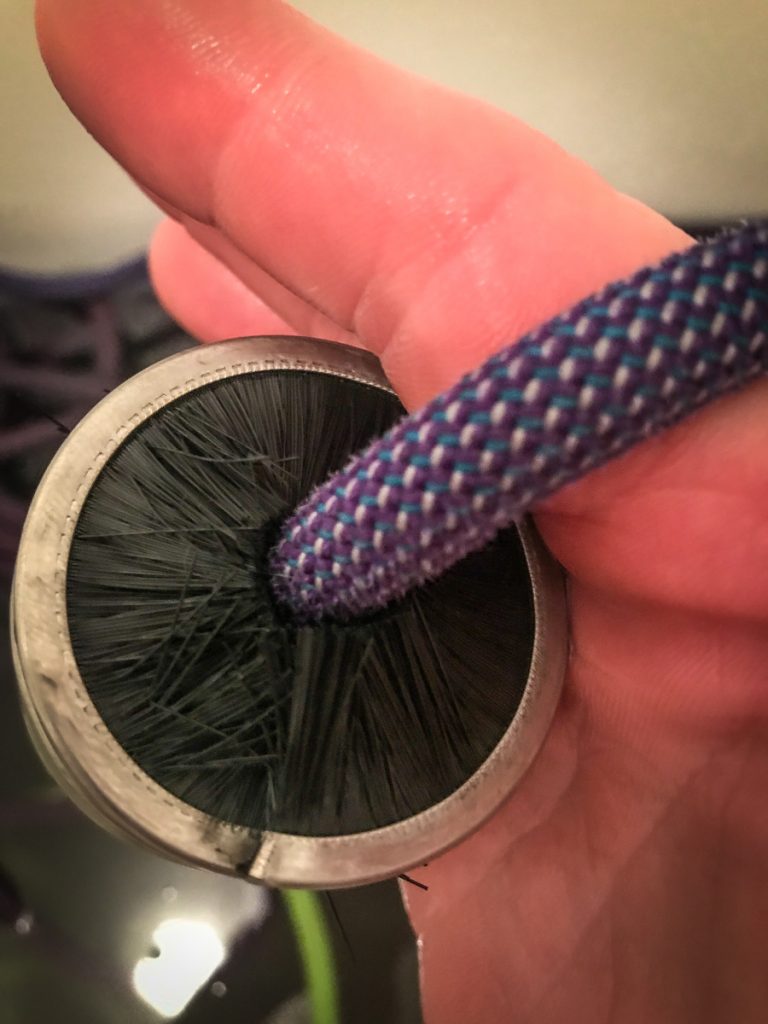
I flaked the ropes into the bath, tying a simple knot in the ends (to make finding them again easier) then filled the bath with enough warm water to cover the ropes, adding the sachets of rope wash. The instructions on the rope wash say to let the rope soak for at least 30mins to allow for ‘maximum penetration’. I came back to mine around hour later and agitated the rope in the water for a few minutes before passing each rope through a rope cleaning brush a couple of times (I bought mine from Amazon but again, BEAL have their own as well). It was pretty amazing (in a grim way) to see how much dirt and grime was coming out of them. The colour of the water was quite impressive too.
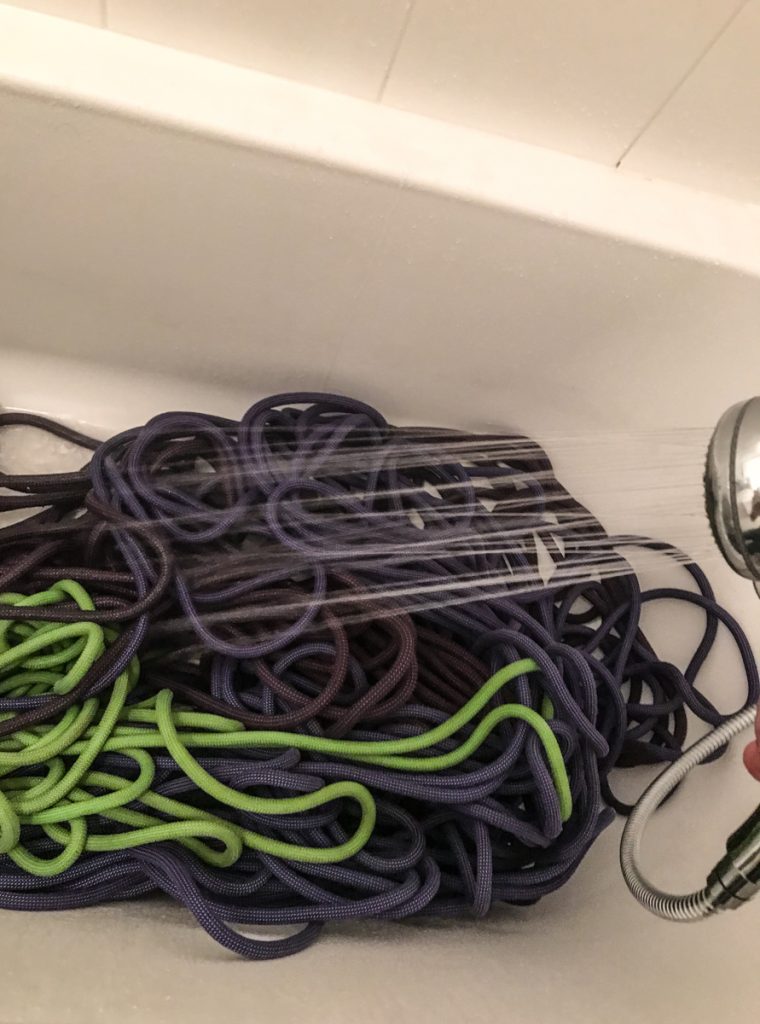
I let the water drain, gave them a good rinse and then filled the tub back up with warm water (no cleaning fluid this time). After soaking them for a bit longer I passed them through the brush a couple more times then drained, rinsed and repeated the process one more time. The idea is to stop once the water becomes clear.
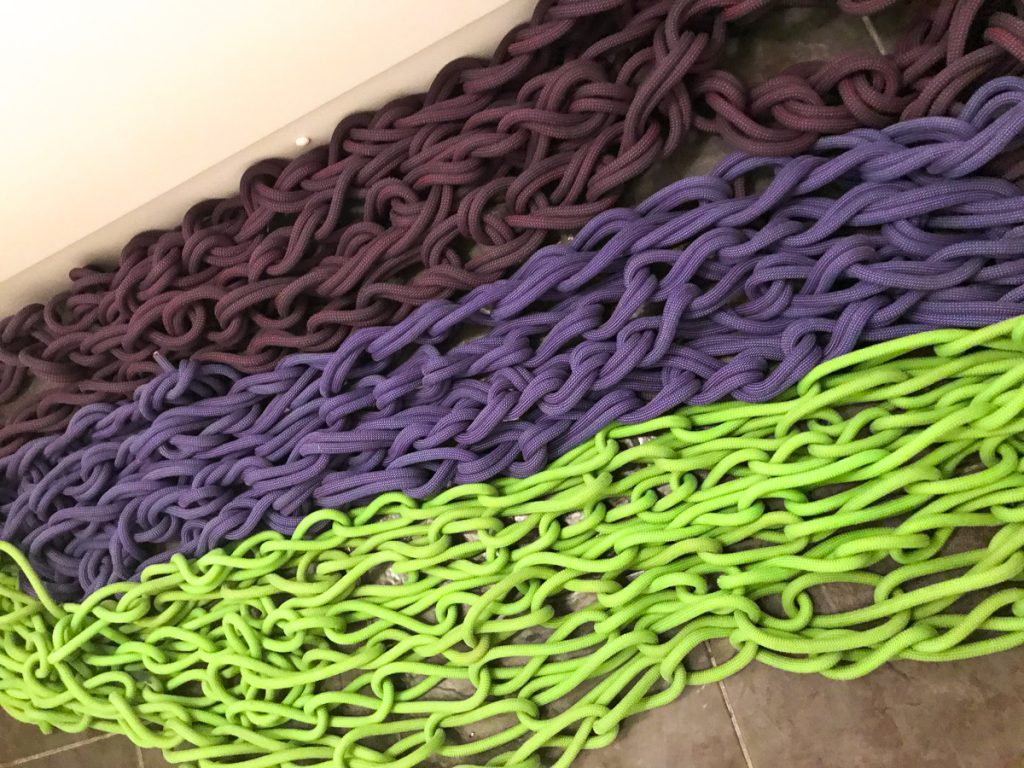
Now comes the matter of drying the ropes! You obviously want somewhere warm and dry but also out of direct sunlight. I left them on my bathroom floor overnight then moved them into the lounge the next day. I laid them out directly on the floor rather than hanging them up, as some manufacturers advise against that. As always with any climbing kit, if there’s any doubt, check with the manufacture and follow their advice. I daisy-chained each rope to make handling a bit easier and for them to take up less space. They took roughly 3 days in my flat before they were fully dry.
It was definitely worth the effort. The amount of dirt that came out of the ropes can only be a good thing for them and they certainly look and handle a lot better now.
How to daisy-chain a rope
Flying visit to Chorro
Monday, December 2nd, 2019
5min read
My life has been quite different these past few months. Work-wise things have been brilliant and busy. Lots of instructing, route setting and shifts at the shop. My home life however, has changed quite significantly as a result of my long term relationship ending. It obviously wasn’t a brilliant period, and as I imagine most people do at similar times, I threw myself into work and keeping myself busy. Two of my friends must have felt sorry for me and invited me on their climbing trip to Spain. They’d had it planned for a while but were happy for me to tag along – and they didn’t have to bend my arm too much!
My personal climbing had yet again taken a bit of a hit in the recent weeks. For the first time ever, finding motivation to go out and climb even on days off and with plenty of rest, was a bit of a struggle. So, I was very pleased with how excited and keen for rock I was getting in the days building up to the holiday. Even the forecast wasn’t putting me off. It was slowly getting worse each time we checked. So much so that Ian made a last-minute decision not to go. A real shame as I was looking forward to catching up with them both. We’ve hardly seen each other for the past couple of years. Mark was still up for going and so was I – the trip was still on. We just packed slightly differently than originally planned. The shorts went back under the bed and the hardshell and waterproofs came out.
We had a plan. According to the forecast, the first day was going to be the nicest day. So we thought that would be our best chance to climb the multi-pitch route Mark had picked out.
El Chorro is extremely easy to get to. We flew into Malaga,
picked up the hire car and were there in less than an hour. Popped into the
train station café to grab some water and snacks and then headed straight to
the climb. Mark had been in the area before so luckily we could get there
without messing around trying to find our bearings.
We got to the crag, got changed, sorted out our gear and started
the very short approach to the climb. The sky was blue, the sun was shining
bright and for the first time in a while I was smiling like a madman and
couldn’t wait to get climbing.
We picked “Valentines Day” a 3-star, 4-pitch 130m 6a. It was absolutely amazing to be climbing on Spanish rock again. I quickly realised this was exactly what I needed. How, just holding on to a bit of rock can make someone so happy is ridiculous. It shouldn’t still amaze me but it does – I freaking love climbing!
We managed to pick a perfect route for the afternoon. It was easy to get to and find, the climbing was fun and interesting but not taxing, so we both moved pretty quickly and were able to relax and enjoy it even more. I ended up leading what was suppose to be the crux pitch and Mark got the last one, which in my opinion was the best one. It was so enjoyable and we didn’t think it was much easier than the ‘6a’ pitch.
It was starting to get dark and the backdrop of El Chorro looked stunning. Ruined ever so slightly by the two smiling morons (yes – us) taking selfies. Just the matter of abseiling back down. Halfway down it got properly dark – no problem with a head torch, I had mine, but Mark however, managed to leave his in the car, even after me reminding him. So it took a bit longer to get down but we got back to the car without any drama.
It had been a long day since leaving Worthing that morning
but we had managed to get to Spain and get a long route in and had a proper
mini-adventure.
We woke up the next morning, expecting rain but were pleasantly surprised to see blue sky. We quickly headed to Frontales after breakfast. The skies were rapidly changing and the temperature quickly dropped. I jumped on “Un monton de chatarra” a Top 50 6a, and it started spitting soon afterwards. It had really set in after ¾ the way up. Even with the rain and numb fingertips and toes, I was still smiling and giving a running commentary down to Mark below who was belaying in the now, full-on fine rain (wets you through). Luckily the holds are positive and I managed to get to the top without slipping off. The rain had just about stopped by the time I got back down but we could see more coming in, so decided to retreat back to the station café. Thinking that was the end of the climbing for the day (and probably the trip as well).
However, the sky gave hope and we were optimistic to get something else in. After all Mark didn’t manage to get a climb in earlier. So after looking through the guidebook, we ended up at Las Encantadas. We were lucky enough to get a couple of hours there, dodging showers but got a few more routes in. It felt like a real bonus as we didn’t expect to get any more climbing in at all.
The rain then set in and the forecast looked extremely bleak for the rest of our trip. Rather than hang around a wet El Chorro, we decided to take the hit and get some earlier flights home for the next day.
Although cut short by a couple of days, our flying visit to
Spain had been a success and completely worth it. I had a brilliant time. The
trip reminded me of how important climbing is to me. It was nice to catch up
with Mark the and we even got to see some old friends who now live near El
Chorro.
A very fun, much-needed trip! More of the same please..
A Year On
Thursday, November 21st, 2019
5min read
Well, it’s been a whole year since I passed my RCI (Rock Climber Instructor) assessment and became a qualified climbing instructor. I don’t want to sound too cliché but this past year has gone so quickly. It doesn’t seem like it was that long ago, when becoming an instructor was just an idea at the back of my mind.
I put a lot of hours into working and shadowing sessions beforehand but passing my assessment, only felt like the beginning. I never wanted to be ‘just’ an instructor, just a job. Becoming an instructor is pretty easy – anyone can learn to rig top-ropes, teach the knots and belaying, look after a group and how to be safe. You don’t actually have to be much of a climber yourself. Climbing in the Peak for over 10 years, I’ve seen a great range of ‘instructors’ out and about on the crags and I’m certainly aware of the type of instructor I want to become or maybe that should be, avoid becoming!
Those who have met me would probably agree that it’s not an understatement to say I’m passionate and appreciative of climbing. It’s opened up a whole new world, life and now career for me. It’s absolutely incredible what it can do for people. The stories you read, hear about and witness are amazing and inspiring. It’s something that’s open to absolutely anyone, any age and ability. It doesn’t matter if you’re scared of heights, suffer with an illness, in a wheel chair, missing a limb or even blind – anyone can catch the climbing bug. People climb for a whole host of different reasons and each get their own benefits from it. It’s part of the reason why I love it and find it so interesting, learning why people climb.
Photo and cover photo by Jez Brown
I want to get the experience and become the best instructor I can be. I want to find that point where I can teach, coach and share my love of climbing and make it look easy. The few instructors I’ve met that seem to have this down to a fine art, have said the key is to never get complacent. You never stop learning and are constantly consolidating each session, taking both the positives and negatives and always open to new ideas and methods. It’s taken them years of experience and work to become the instructors they are. Like anything in life really – there are hundreds of hours of dedication to give the appearance of making something appear effortless.
I was in the fortunate position to have work straight away at my local climbing wall. It’s obviously indoor rather than outdoor based but I’ve really enjoyed it. Working on NICAS (7-16 year olds), introduction and improver sessions, I’ve had chance to work with a variety of age groups and a whole range of abilities. You would think that indoors should be an easier working environment. However, strangely, I quickly noticed that wasn’t the case for me. I’ve always been an outside climber, only retreating indoors when the weather forced me to do so. Outdoors has always been my happy place, where I get excited about climbing and as a result I’m naturally relaxed and found it my natural environment to teach. It’s taken some extra effort and time to feel more comfortable to teach indoors.
I’ve taken this past year pretty steady. An intentional effort that I’ve made from the start, not wanting to run before I can walk. It’s all been a bit of the unknown for me – working as an instructor is quite different to working from home, behind a computer, something that I’ve been doing all of my working life. I was slightly worried about how I would cope with both the physical and mental demands of instructing and how it would affect my illness.
It wasn’t just my health I was thinking about but also partly my own personality. When it comes to anything I do, whether it’s work, DIY, woodworking – anything, it has to be perfect, the best job I can do. I can drive myself (and others) crazy and this is definitely more of a flaw, rather than a quality of mine! As such, I didn’t want to just jump into the instructing world with both feet, before I believed in my head that I could do a good job.
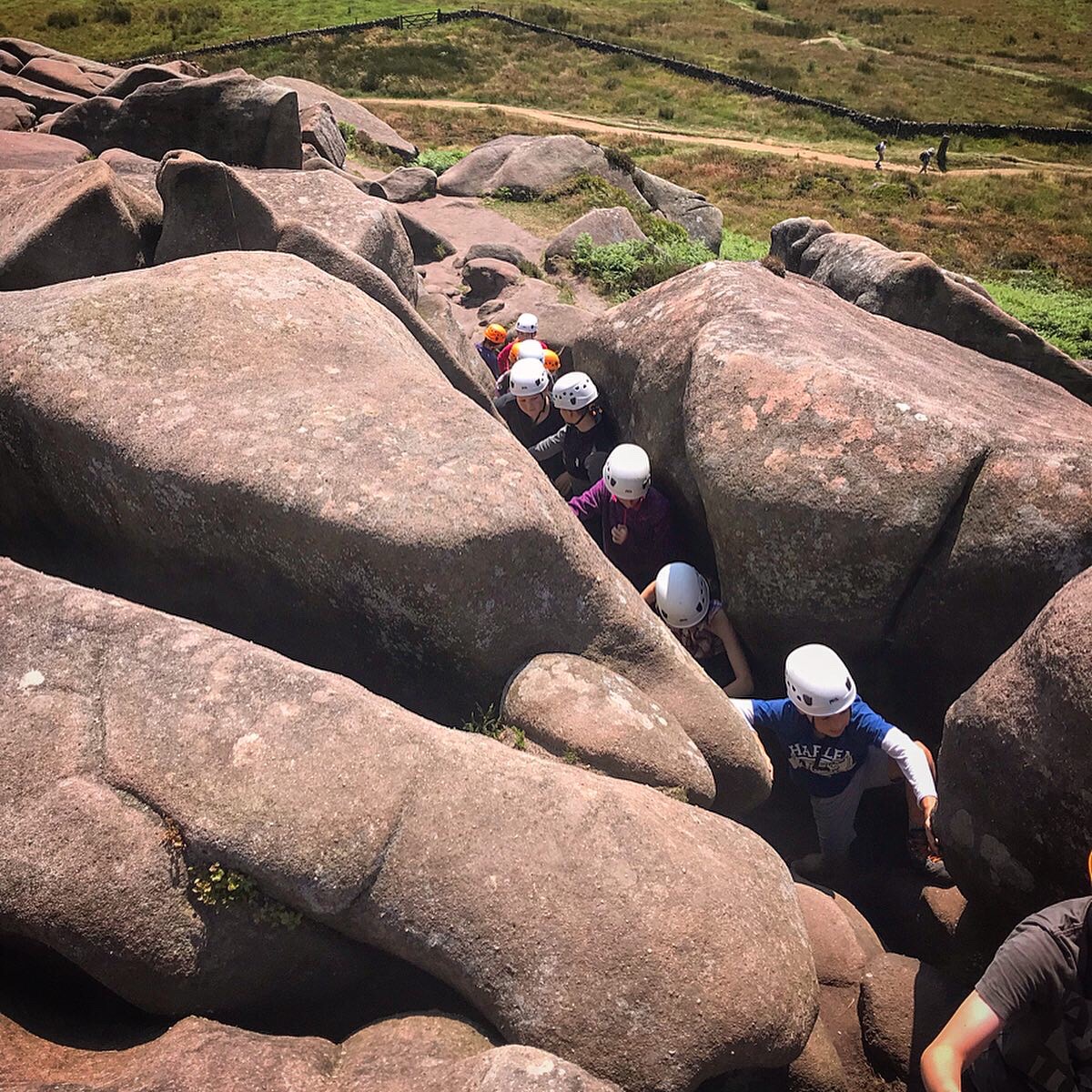
So I wanted to take it slowly. Pace myself while building up experience and trying adjust to my new work life. Something I think I have achieved this year. As well as the climbing centre, I’ve also worked with a small handful of companies as a freelance instructor. It’s been brilliant, I’ve had some amazing days with groups and clients. working in the Peak, thinking how lucky I am to get to call this a job.
This past year, I’ve worked with a huge range of clients. From children to adults, individuals, groups and parties, to families, quiet, loud, calm to (somewhat) organised chaos. I think I’ve managed to get something from each session and day. I’ve learnt lots myself, how to adapt and interact with different clients, what works and more importantly what doesn’t.
I’ve also been back to North Wales for more training this year. When I was doing my RCI training last year, there was mention of an add-on to the award in the planning stages, that would allow you to teach leading at single-pitch venues. Well, Mountain Training released it earlier this year – Rock Climbing ‘Development’ Instructor (RCDI).
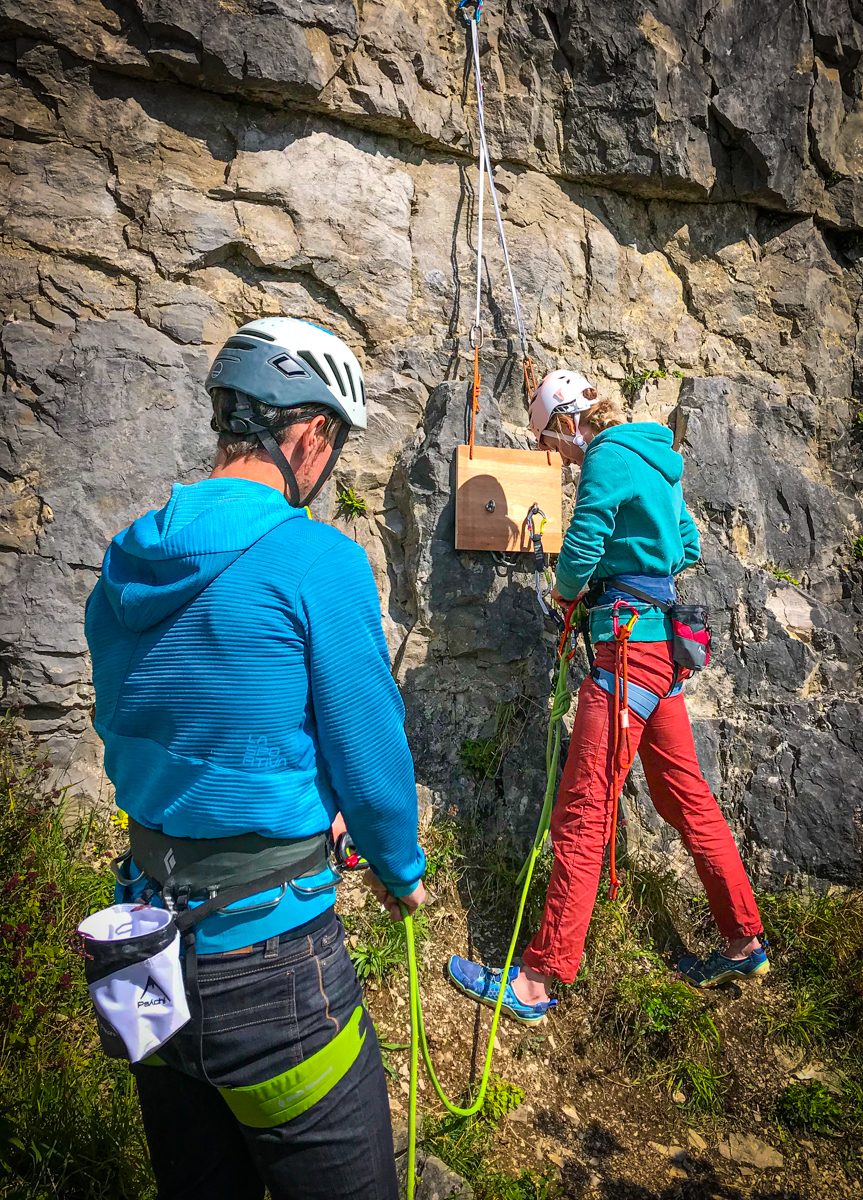
I went back to Jez (JB Mountain Skills) for the training. Not only was it his first RCDI course, but it was also the first one to be run in Wales. I quickly realised it wasn’t just a ‘bolt-on’ to the RCI but a completely different level of qualification. In 4 days we covered an insane amount of content. I really enjoyed it though, it was great fun with lots of discussion and feedback about the award. I’ve come away with a lot to think about. I’m really going to enjoy working towards this qualification. I’m very, very excited by it. Being able to teach and develop someone into a fully independent climber would be incredible and something that I know I’d get great satisfaction from.
Working inside at Outside
Wednesday, December 5th, 2018
3min read
With me not actively trying to secure more IT work and the fact that I was only volunteering at my local climbing wall, I thought it was probably a wise decision to start looking for a part-time job to help pay the bills.
But what? From speaking to outdoor instructors, the majority said you need another source of income for the quieter, winter months. So, I didn’t want any job, it would hopefully be long-term, it had to be something I’d enjoy and get excited about. Otherwise, I might as well just stick to IT, however, just the thought of that made me an unhappy Charley.
Turns out, I didn’t have to look too far. Outside, the outdoor shop in Hathersage, the place that has been the central hub for my Peak climbing days, were looking for part-time staff.
If you’re into the outdoors and have been to the Peak District, chances are you’ve paid a visit to Outside. It’s an independent family shop, first opened by Dick and Sally Turnbull in the 80’s, it’s now run by their two sons Rob and James. I can’t even begin to add up how many hours I’ve spent there over the years, or even worse, dare add up how much of my savings I’ve spent on gear. However, it’s one of my happy places. Even when the weather hasn’t played ball and scuppered the days climbing, a visit to Outside to look at gear I don’t really need (and can’t actually afford), chat to the staff and have a cup of tea in the café still makes the drive over worthwhile.
I’d never worked in a shop before, absolute zero retail experience but I’d spent so many hours browsing around the shop that getting paid for the privilege seemed like a good idea. Plus, the timing was perfect.
Just the small matter of sending my CV in and going for an interview. Since leaving school at 12, I’ve only had one job interview and that was years ago. Everything else before and after, I’ve been self-employed. What on earth do you in an interview? What questions will I get asked?
As usual, I was overthinking. My ‘interview’ was on the shop floor, in-between James serving and talking to customers and basically went along the lines of “when can you start?”!! Well, that was easy. I stopped for a quick celebratory climb at Burbage North on my way home. Feeling lucky that I’ll get to work at my happy place and have the opportunity to drive past crags on my way home.
You’ll most probably (and rightly so) judge me for this but as luck would have it, at the time I started working at the shop, within a week of each other, two full-time members of staff had climbing accidents. Small, little accidents (I’m not totally heartless) but resulting in one broken heel and one broken wrist between them, meant they were out of action for a few weeks. Now, where I really lucked out (try not to judge me too much, I have a very dry sense of humour) they both usually worked in the gear room. So not only were there plenty of shifts to cover, it also meant that I got lots of quality time working in the climbing room – my safe, familiar place. Where I get to talk about climbing all day, advise and sell people the best gear for their next adventures.
I’d admit that to some people, a 30 something-year-old working a part-time retail job on a zero-hour contract may not sound like the ideal career choice. There’s nothing wrong with that viewpoint, I can fully understand their way of thinking and priorities. My outlook on life is slightly different but far from atypical. I’m not the most ambitious person when it comes to work. My priorities have always been about health, happiness and family. I’ve learnt that life can be short and energy is precious so I need to try and make the most of good days and make those happy memories when you can.
Working at Outside over the past four months has been brilliant and so much fun. Shifts aren’t always available or overlap with other work so, isn’t always regular but I’m loving it. It’s such a friendly place to be. Somewhere where you’re made to feel appreciated and part of the family rather than a team. Sally (Rob & James’s mum) still works in the shop to help with busy periods. The first time I met her, she asked if I was enjoying the job and if I was coping with work and my illness. It took me by surprise at first, as it’s not my usual topic but obviously she must have found out from James. Which just showed me that she’s still very much involved in the business and how the family cares about their staff. I can still remember how genuinely interested she seemed to be in me and my wellbeing. Which meant so much. It’s really true, that if you look after your staff and treat them well, they’ll want to do their best for you and that’s definitely the case with Outside. Oh and the staff discount doesn’t do any harm either.
What have I climbed this summer??
Saturday, September 15th, 2018
3min read“So, what have you climbed this summer? Been away much?”
It wasn’t until I overheard a couple of climbers comparing their recent adventures, then went on to ask me, what I’ve done, I realised that I haven’t. What HAVE I climbed? Where HAVE I been?
Apart from a couple of fleeting visits to North Wales, I haven’t been anywhere! I’ve only really been bumbling around the Peak, even then I haven’t pushed myself, got scared, had any whisky fuelled adventures or a single epic that I can recall. I haven’t climbed any multi-pitch or been anywhere near a sea cliff. How have I missed this summer? I haven’t even had any camping trips in the Peak? The staff at the Indian in Hope were concerned when I went in the other week after work, asking me where I’ve been all year and if I had moved away. Apparently, the amount of times I used to go in there, they assumed I lived in the village.
“Hmm, not that much really! Just been around the Peak” is all I could quietly reply, holding my head slightly lower.
I knew I hadn’t been climbing much but it wasn’t until I actually stood and thought about it, I realised that I REALLY hadn’t. It might sound ridiculous, but I slightly panicked, for the past 10 years climbing has been my only focus in life. Just the thought or slightest mention of it brings a smile of happiness to my face, even on the crappiest of days – but I’ve not done anything this year!! What’s happened?? Over the years, climbing has totally transformed my life and without a doubt, has helped me with my illness. It certainly hasn’t always been easy but the positives I get from it are worth the negatives that I can suffer. I have so much to thank for it – I owe climbing so much. I suppose climbing is my first love and as silly as it may sound, I feel guilty that it’s no longer my main focus and that I’ve been neglecting it.
My life has changed completely. I’ve been with my girlfriend for the past 18 months. Lisa has two amazing and brilliant children and in that time, we’ve become a happily blended family. My life and routine have completely been turned upside down and as a result, my usual pacing, recovery and coping mechanisms are no longer helping and I’m having to learn to re-adjust.
Sleep-ins and lazy starts have been replaced with being woken up at 6:30 in the morning to watch Winx with Holly, helping with the kid’s breakfast and getting ready for the school run. Days off are obviously now split between climbing and family – baking cakes, making dens, family trips, playing games, colouring, battling supervillains and reading bedtime stories. And I absolutely love it. These three amazing and beautiful people have welcomed me into their lives and we just work so well together!
I’ve amazed myself at how I’ve managed to keep up without a having major relapse. However, I’ve found that my new life has slowly caught up with me. Quiet, isolation and rest used to be my first lines of defence. Now, with a 6 & 9 year old in my life, I’m knackered, my sensory overload is normally so high and I’m finding it hard to recover, even on my rest days and as a result, my symptoms have knocked up a few notches and I’m having fewer ‘good days’. The fact that we started the year off by getting a puppy, probably hasn’t helped. Beanie, our miniature dachshund nearly broke us both in the first month and did actually trigger a relapse. And then, because the year hasn’t been busy enough, I’m now in the middle of a career change.
Days when I have to make an effort and actually pretend at being a civilized, functioning member of society or just to get something done, I have to ignore and overcome every sense in my body. My symptoms don’t disappear just because I make an effort, it can feel like a constant battle, which is exhausting in itself. So my rest days used to be just that – rest, complete rest, alone in my flat! Usually involving long sleep-ins then moving to the sofa once feeling capable, with the curtains drawn and the lights dimmed. Trying to cut out as much sensory stimulation as possible. I’ve tried having rest days at Lisa’s and even my parents but it simply doesn’t work. However, resting alone in my flat no longer has the same appeal when I’ve got three amazing people that I can be spending my time with. For the first time I have something more important in my life than just climbing.
So I have a new challenge – to try and re-adjust the balance of living with M.E, my new life and family, a new job and hopefully fit in a bit more climbing. Whether it’s possible to have everything remains to be seen, but I’m happy for climbing to take a back seat while I work on it.
So what have I climbed this summer??? Not much but I’ve had a bloody amazing year!!
Becoming a climbing instructor
Thursday, June 7th, 2018
4min readI first started climbing at my local wall in 2008 and it didn’t take me long to realise that it was something I quite enjoyed. After a few visits, I organised for one of the instructors to take me climbing outdoors.
We arranged to meet at a shop called ‘Outside’ in somewhere called ‘the Peak.’ I had obviously heard of the Peak District, however until that day had never been.
Driving over that morning, the weather wasn’t the best and it didn’t stop raining until I got past Chesterfield. I couldn’t see how we would possibly get anything done. However, I met the instructor and followed him to a crag called Yarncliffe. By then, the sky had started to clear and the weather improved. I watched how Paul, the instructor, setup a top-rope and then we went back down to the ground where he showed me a climbing rack and how all the shiny bits of metal worked. He then pointed me in the direction of a route. My first climb on real rock! With the safety of a top rope, I did a mock lead, placing (fumbling) gear in as I went up. The climb was still damp from the rain but that didn’t detract from the experience.
Climbing indoors had been fun, but nothing compared to climbing outdoors. Not realising at the time, this one route completely changed the direction of my life.
Fast forward nearly a year and I’d climbed over 250 routes, had made some good friends and had many adventures. It was safe to say that I’d caught the climbing bug hard.
A friend was interested in doing the ‘Single Pitch Award (SPA)’ and wanted me to join him. It’s a nationally recognised award that allows people to become qualified climbing instructors and teach at single pitch climbing venues. Although I kind of loved the idea that I could perhaps turn my new found love into a job, I don’t think I was ever seriously considering it. I was still trying to figure out how to manage my illness with climbing as well as the small matter of my shyness, which together with a lack of confidence and social anxiety thrown into the mix– were possibly not the best qualities for an instructor.
I loved climbing and was always keen to learn as much as I could to become a better and safer climber. So booked in on the training course, hoping to learn some new skills.
Unfortunately, the training weekend left me feeling very uninspired and any enthusiasm I had quickly faded. I didn’t feel as if I had learned anything that I hadn’t already been doing for the past year other than the group abseil setup – and even that was taught with an “it’s not how you should do it, but this will do” attitude. The weekend definitely didn’t give me any confidence or inspire me to become an instructor and unfortunately really gave me a negative outlook on the SPA scheme.
Fast forward a few more years to 2018, 10 whole years later and my life was now purely focused around climbing. Without a doubt, it was helping with my illness, mental well-being and had a hugely positive impact on my life.
For the past year, I’d made a real effort to become more confident and was trying to battle my social anxiety which I recognised was holding me back from leaving my comfort zone. I always felt that my social skills had regressed over the years I was stuck at home with ME and then just ignored while I tried to deal with my illness. However, I was now seeing a positive outcome from my efforts.
Then a few things happened at once – my current freelance IT work was starting to slow down and I wasn’t really feeling the passion to get more work in.
At the same sort of time, I’d read that the old SPA qualification was being updated and was changing to the RCI (Rock Climbing Instructor) and when a fellow Instagrammer and Mountain Training provider posted some dates for the new RCI training course, I found myself booking it. I couldn’t think of a better way to leave my comfort zone and start a new chapter in my life. The time had come for a change and a new challenge!
From visiting many crags over the years, I’ve witnessed a shocking number of questionable climbing instructors and sessions being run, from what I consider to be bad practices or just plain boring. I’ve also seen some brilliant instructors too, ones that not only know their stuff and are safe but also you could actually see them passing their passion for climbing onto to their clients. You can be the safest, most professional instructor possible but if you don’t deliver a fun session and share that passion, what’s the point? What makes you stand out from the hundreds of other instructors?
One instructor that I’d been following on social media after meeting a couple of times, is Jez Brown. His posts and photos are great and fun. You can see that he loves his job, loves climbing and is passionate about what he does. It was a no brainer to book my training with him.
The Rock Climbing Instructor (RCI) training is a three-day course. An indoor day, at a local climbing centre and two days out on the crag. I headed to Wales excited yet also slightly anxious as after my previous training weekend all those years ago, I wasn’t totally sure what to expect.
I needn’t have worried at all as it was a brilliant few days away. After climbing for 10 years, I considered myself to be an experienced and safe climber – the ropework and technical side of the RCI was very stress-free but I still managed to pick up loads of tips and it gave me plenty to think about. Jez provided excellent training. He has a very relaxed and fun attitude yet doesn’t seem to miss a trick, is full of useful tips, advice and experience. His love of climbing and his job is obvious to see and it really shows throughout his training.
The difference between Jez’s training course and my original one is night and day. In fact, it’s not fair to even try and compare them but just highlights the differences between instructors and how they can affect their clients.
I came back from Wales feeling really inspired for the next stage.
The safety and technical side is one thing, but the actual instructing and teaching side is another. The RCI syllabus now covers this more compared to the old SPA, however, I know this is definitely a weakness of mine and something that I’ll have to work on to build my confidence.
I’m fortunate that my local climbing centre is being very supportive and encouraging by letting me shadow and help out. Hopefully, I’ll be able to get some outdoor shadowing experience as well and then it’ll just be the matter of consolidation before booking my assessment.
Climbing with M.E
Sunday, May 8th, 2016
8min readClimbing in the sunshine in the magnificent Llanberis Pass, everything feels perfect. I’m climbing a route called “Cemetery Gates”. First climbed by the legendary duo Joe Brown and Don Whillans back in 1951, it’s a great looking line on the impressive yet daunting Dinas Cromlech. A climb that has always been on my wish list since I first started climbing but never really expected to try.
Yet here I was on the second day of a trip to North Wales, feeling tired from both the previous day’s climbing and the steep walk-in to reach the bottom of the route. I felt exhausted and apprehensive before even touching the rock but it only took a few moves into the climb before I started to relax and focus on the climbing and soon I couldn’t stop smiling. Before I knew it I was over 40 metres up and realising that I was past the crux and actually had a good chance of getting to the top – I started to appreciate my surroundings even more. Surrounded by rock and mountains, looking down on the Pass – the exposure was incredible. The fact that I was exhausted didn’t even come into it, I was just focused on the climbing and feeling fantastic, loving the experience.
Sitting at the summit of the climb in the afternoon sun while belaying my friends, I can relax even more, slightly amazed that I made it to the top. However, I can feel my body slowly catching up and reminding me that it’s had to work hard to get me up here.
This isn’t the hardest climb I’ve done, however it’s certainly one of the most memorable & sums up why I love climbing. It’s not just about the actual climbing itself, but the whole adventure – travelling to new places, being in stunning situations, sharing it all with friends and the all-important trip to the pub afterwards.
I was 22 when I discovered rock climbing and was instantly addicted! Speaking to other climbers it was the same for them – but mine isn’t the average story. Before climbing, I had no real interests, was unfit and had no social life – climbing changed my life overnight.
I’ve had Myalgic Encephalomyelitis, otherwise known as M.E for the past 19 years. It’s a multi-system disease affecting not only the neurological system but also the immune, musculoskeletal, endocrine (hormonal) and cardiovascular systems causing a whole host of symptoms which vary from person to person but include persistent exhaustion, aching joints and muscles, chronic migraines, sleep disturbance, hyper-sensitivity to light and sound and cognitive impairment.
The NICE (National Institute for Health and Care Excellence) guidelines state the physical symptoms can be as disabling as multiple sclerosis, systemic lupus erythematosus, rheumatoid arthritis and congestive heart failure. It’s been recognised by the World Health Organisation since 1969 as a distinct organic neurological disorder, however, sadly little is still known about it, not helped by the fact that funding for research is seriously lacking. It’s estimated to affect around 250,000 people in the UK.
There are a lot of negative attitudes towards M.E, it’s a widely misunderstood illness and it doesn’t help that there have been many conflicting (and mostly inaccurate) articles in the press and misleading papers published over the years. It’s not just feeling tired all the time, it’s certainly not laziness and isn’t something that can be cured with happy thoughts and exercise. It’s a devastating, life-changing illness which is a constant daily battle and can affect men, women and children of all ages and leaves most sufferers bed or house bound.
So what’s M.E like?
Have you ever gone to bed one night feeling fine but then woken up with flu? Out of nowhere you’re struck down with illness. Feeling pathetic and useless – completely drained of energy, achey muscles and joints, thumping headache, you can’t think straight, simple tasks feel much harder and you’re generally just feeling like death? Well, that’s kind of close to M.E except instead of feeling better after a couple of days, you don’t. Unlike the flu there aren’t countless medications and remedies available to help ease the symptoms and recover. Instead it gets worse and doesn’t last just days but becomes a constant way of life.
There’s something called the ‘Spoon Theory’ which is often used to explain what it’s like living with an invisible illness like M.E. Personally the spoonies has passed me by, I prefer the battery analogy;
If you think of your energy as a battery, an average person has got a new, fresh, healthy battery which holds its charge well and recharges quickly. You can go out in the day use 20% of energy and after a night’s sleep you’re back at 100% ready to start all over again. Whereas the battery of someone with M.E is completely knackered – it drains ridiculously quickly, takes much longer to charge but never reaches 100% no matter how long you leave it charging. They can go out and have the exact same day, however they use 40% and next morning after a nights sleep they’ve still only re-charged to 60%. They use up their energy quicker than they can recharge it and when it reaches a certain level they relapse.
Unfortunately this all important relapse level is invisible and as soon as it’s reached, M.E knocks you straight to the floor. Not only is the mark invisible, the real kicker is that it keeps moving throughout your illness so you never know exactly where it is – which makes trying to pace yourself near impossible especially as doing ‘too much’ some days can be as little as getting dressed.
Some people may find it hard to imagine that someone suffering from a chronic illness can go out and climb a rock face. When I was at my worst, during the first few years of my illness, I was pretty much housebound. Just getting out of bed, getting dressed and going downstairs would have been a bigger challenge than attempting Everest. Leaving the house, travelling and then walking up to the crag and going climbing for a day would have been totally unimaginable. Thankfully though, I’ve been slowly recovering over the years and my energy levels have greatly increased. It’s taken a while to get to where I am today, it’s been very much a one step forward and three giant leaps back sort of progress.
I still have the majority of my original symptoms but I’m much better at dealing with them and pacing myself. Anyone who knows me knows that my attitude is generally “turn up and do” – although dealing with M.E does mean that I need to try and structure my days as best as I can to make sure I have enough energy to go around and avoid causing a relapse. Unexpected events no matter how small can have a knock-on effect and cause problems.
When I climb rock something awesome happens (no, it’s definitely not skill or flawless technique); I’m not sure if it’s the adrenaline or just the fact that my head’s cleared and focused on the climbing or a mixture of both, but I feel amazing! It sometimes only lasts for a couple of moves, however in that time I forget about M.E and my symptoms and just enjoy the climbing – it’s a brilliant high and the only thing that I’ve found in all these years that helps me to escape even if it’s only for a minute or two.
Climbing is very flexible which is why it suits me. You can do as little or as much as you want and still have a good day out. It’s not just about climbing rocks but the whole experience of being there.
When my symptoms kick up a notch but I’m not too ill, I try and head outside on my own. I usually don’t feel like I have enough energy to meet up and climb with a friend so I go soloing instead. I can set my own pace and climb as much as I’m able. I find soloing completely relaxing, more so than when I’m climbing with a rope. That feeling I get is intensified, I become completely focused on the climbing and the fresh, clean air is brilliant at keeping migraines at bay.
As much as I love climbing, the downside is that it’s completely knackering and I usually end up spending more time recovering than I do on rock. If you see me at a crag I’ll usually be having a great time, having an epic on a route and moaning about the weather – you won’t see my illness and that’s not just because it’s an invisible illness but because when you live with M.E you quickly become a master at pretending to be healthy. I really try my best not to show that side to anyone. It’s not necessarily because I want to hide my illness but more of a coping mechanism and a way to get through the day.
It’s not easy writing about all this. I normally keep my M.E private, it’s not something I talk about or share with anyone. I’m not entirely sure why, maybe it’s just become habit over the years and the way I deal with it.
Positive thinking is a necessity when dealing and coping with M.E, I’ve grown up to always try and focus on the positives no matter how small and on what I can do rather then languish over the negatives and as a result I try not to complain about it. Well actually, I moan all the time but never usually about anything important although I’m known to whinge on about being tired when I’m struggling but I think most people just see it as a common climber’s excuse!
I also don’t want people to think of me any differently or even worse, make allowances. There’s also the stock responses you can get after someone learns you have M.E – “you don’t look ill!!” or the classic “yeah, I was really tired last week too!!” or the people who think you can just snap out of it or that changing your diet or doing exercise will magically cure you. I know most are just trying to help but it really doesn’t.
I’m probably too harsh, after all if I don’t ever talk about it I can’t expect people to understand. I’ve been ill for a long time and it’s shaped my life so when you remove M.E from the conversation there’s not much left to discuss. I feel bad when I’m talking to someone who is sharing their stories and who ask me about my life. I don’t go out of my way to lie but I do avoid mentioning M.E even though it would probably answer a lot of their questions and make me seem slightly less weird and also help explain why I’m so pathetic some days and get tired so quickly or why my brain sometimes turns to mush.
The positive side of becoming ill so young is that I’ve got nothing to compare to, for me this is normal and all I’ve ever known. On a day to day basis I don’t see myself as being ill. Yes I have an illness, however, I don’t see it as a disability – it just is what it is, I just have to accept my limitations and in the great scheme of things I don’t actually have too much to complain about. After all, everybody has their own problems and everyone has challenges in life.
I’ve improved so much over the last few years and I like to believe that I have climbing to thank for that – as a result my life currently revolves around it. I go climbing as much as possible, making the most of good days and when I’m not climbing, I’m crashed out in bed or on the sofa trying to recover and somewhere in between all that I try and fit some work in to pay the bills and fund the next trip. I rarely have spare energy for any other interests so when I say climbing is my life, I really mean it – I eat, sleep and dream it. I know it makes me a bit of a sad bastard but currently it works for me and the positives far outweigh the negatives.
Climbing has changed my life for the better, it gives me a reason to remain positive, something to look forward to on bad days, takes me to amazing places, gives me a way to make friends and socialise and then there’s the actual climbing itself – a totally addictive experience which brings a whole bag full of emotions, challenges, enjoyment, sense of achievement and most importantly of all – epic adventures.
May is M.E awareness month which is why I thought I’d make the effort and share my story. This will hopefully give a small insight into M.E and how climbing helps me live with my illness.
About
Climbing Instructor
Route setter
I was diagnosed with Myalgic Encephalomyelitis (M.E) when I was just 12, something that dramatically changed my way of life.
At 22, I discovered climbing. This amazing, brilliantly wonderful obsession that gave me the opportunity to grab my life back again
10 years on and I still absolutely love climbing, love being outdoors, exploring new places and having fun.